A gentle way to keep older adults moving—hands, wrists, and mind, together.
The RunOrb is a gyroscopic coordination device with adjustable resistance and BLE data export—built around a supervised group or one-on-one activity protocol.
How It Works
Two things make it different from a dumbbell or grip ring.
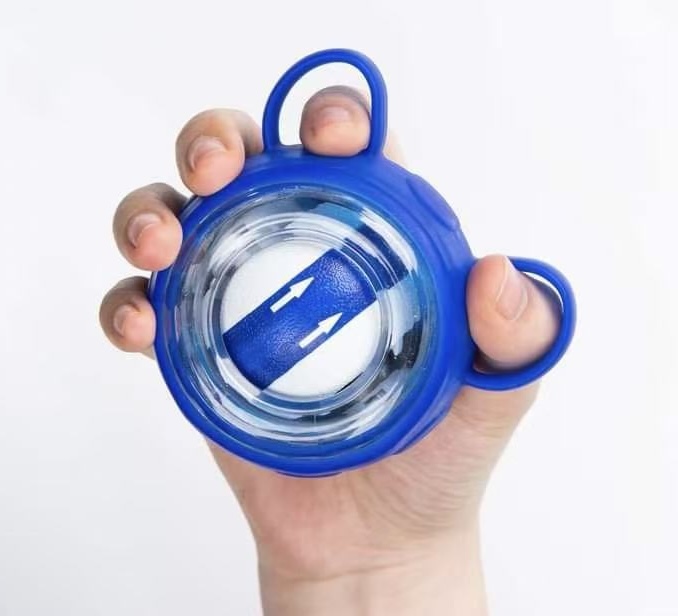
★ Adjustable Resistance, including a low-start variant
Most older adults in our pilot could not start a standard resistance ball on their own. So the RunOrb uses a low-start variant, if some elders could not start RunOrb, then lets a caregiver, CNA, or companion-care visitor assist with the first few rotations, then hand it over.
- One device fits residents across independent, assisted, and nursing care levels.
- Staff spend less time per resident, so group sessions actually scale.
★ Gyroscopic Rhythm Sync (not a dumbbell, not a grip ring)
Inside the ball, a rotor spins at a rhythm the user must sense and synchronize with. Keeping it going takes wrist and finger force and timing—so the hand and brain are working together the whole time.
- Alternating left- and right-hand use encourages bilateral coordination as part of a daily routine.
- Unlike lifting a dumbbell or squeezing a grip ring, the movement has a rhythm the user has to match—this is the part that makes it feel engaging rather than repetitive.
Protocol
- Low-impact, seated or standing
- One-on-one or small group
- Staff-led "3-1-3-1" protocol: 3-min warm-up → 1-min ball → 3-min cool-down → 1-min check → 1-min cool-down
Find Your Own Rhythm: The Gyroscopic Resonance Effect
In extensive hands-on testing, we observed a phenomenon unique to RunOrb that distinguishes it from dumbbells, jump ropes, or running: gyroscopic resonance.
★ Not You Driving the Ball — The Ball Guiding You
Conventional exercise relies on your continuous active effort: stop pushing, the movement stops. The RunOrb is different. Once the inner rotor spins up, its significant rotational inertia keeps it turning on its own. You don't force the ball to keep moving — the ball's stable rhythm gently guides your hand to follow along.
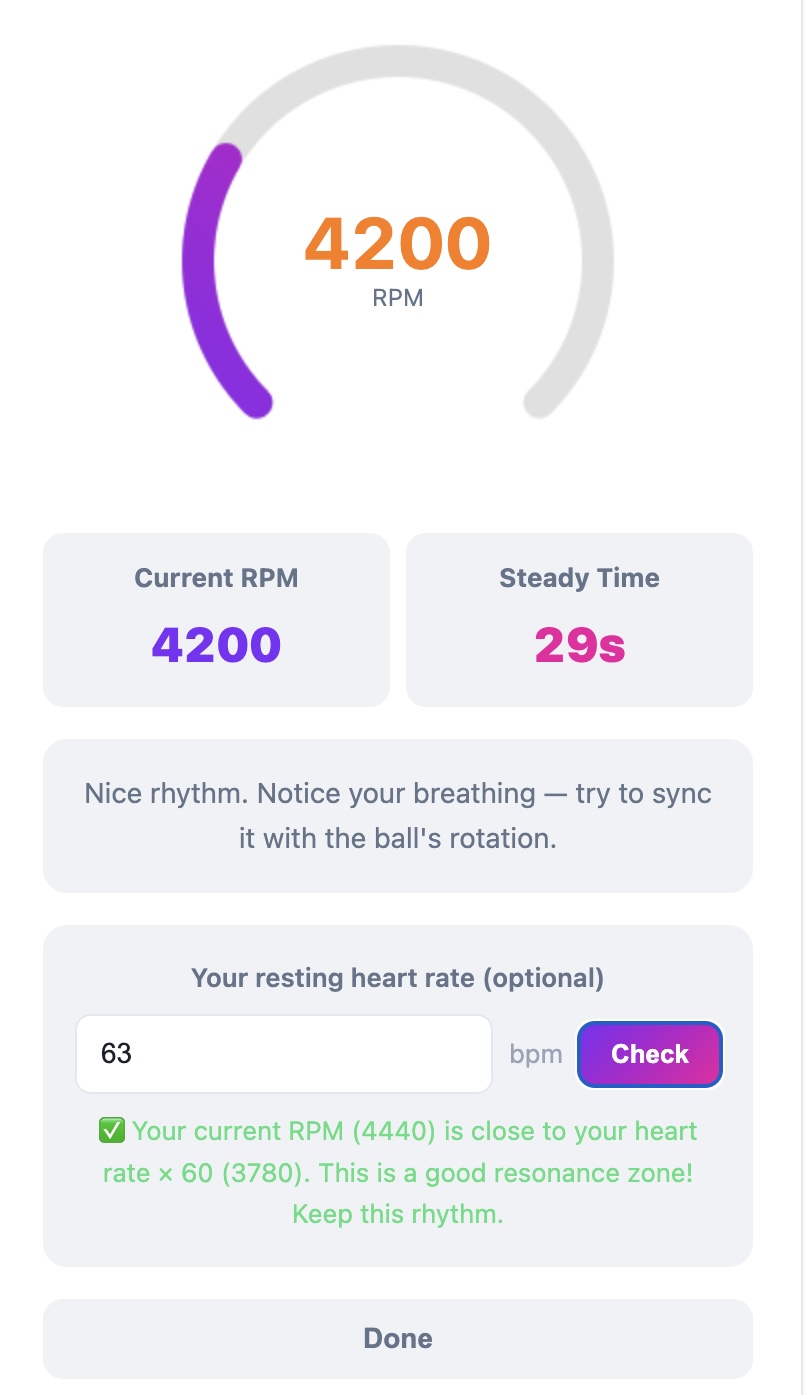
★ Everyone Has a Different Resonance Speed
There is no universal "correct" RPM. Each person's body, resting heart rate, and neural sensitivity are different. Users slowly adjust the ball's speed, fine-tuning until they find their own personal frequency zone — the pace where the rotation rhythm begins to align with their heartbeat and breathing.
When that synchronization happens, something remarkable occurs: the steady pulse travels up through the arm, easing tension, creating a sensation described as "a gentle massage for the brain." Mental chatter fades. The body settles into a calm, relaxed state.
How It Works
- Strong inertia: The high-speed rotor has significant angular momentum. Once stabilized, inertia sustains the rotation — forming a stable, continuous external rhythm that doesn't stop at every tiny hand pause.
- Individual variation: Each person's resonance speed differs. There's no standard setting — users feel their way to their own comfortable rhythm.
- Passive-follow rhythm: Traditional exercise is entirely user-driven. RunOrb's inertia creates a sustained beat that the body follows — making it easier to align breathing and heart rate with an external pulse, achieving neural relaxation.
Who Benefits
This makes RunOrb a low-load, self-paced movement suitable for knowledge workers, chronically stressed individuals, older adults, and people across all ability levels. It doesn't pursue high-intensity exertion — instead, it uses inertia-driven rhythm to help users regulate their physical and mental state.
We continue collecting user data through the REI Vitality Index system to further study individual rhythm patterns and refine this all-ability wellness approach.
Vitality Data & Integration
Every session creates a record—easy to add to a community's quality documentation.
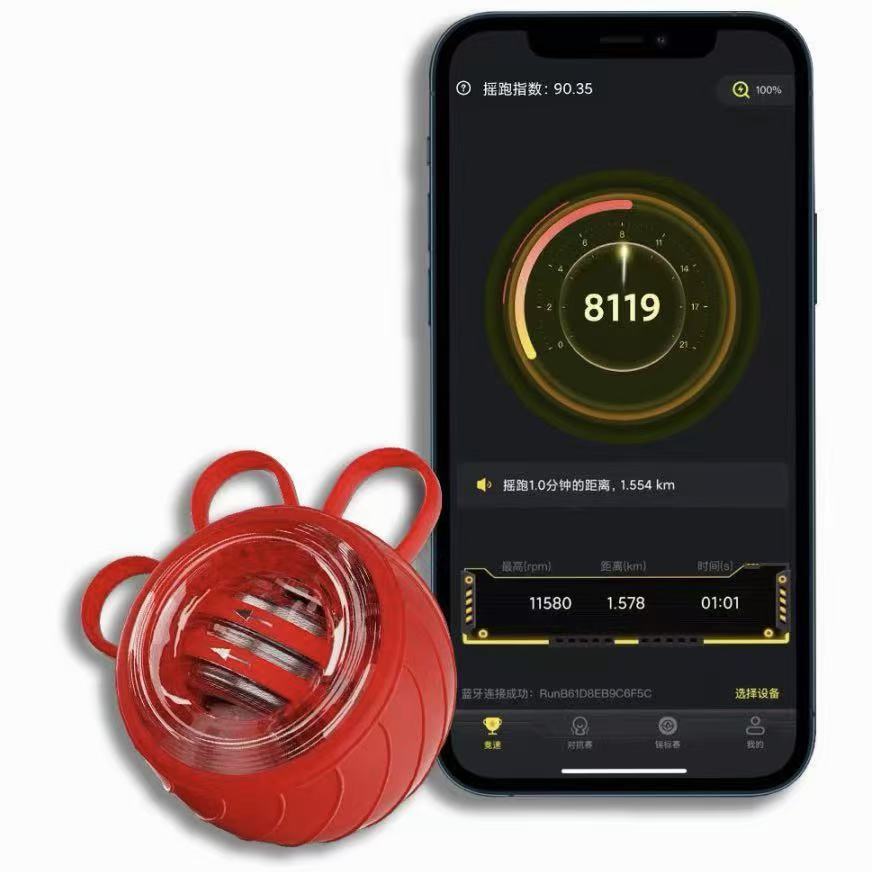
Real-time RPM / distance / vitality index via BLE
What it tracks
| Metric | Shown on | Exported as |
|---|---|---|
| RPM (revolutions per minute) | Smartphone / Computer | CSV via BLE |
| Session time | Smartphone / Computer | CSV via BLE |
| Equivalent distance | Smartphone / Computer | CSV via BLE |
| Vitality index | Smartphone / Computer | CSV via BLE |
Specs
20 residents. 400 sessions. Zero safety incidents.
Two 20-session rounds, five days a week, supervised one-on-one by social workers and interns. Residents ranged from 64 to 90; more than 70% were over 80 and included independent, assisted, and nursing-care levels. All data de-identified.
| Metric | Before | After |
|---|---|---|
| Avg. max RPM (1 min) | 2,000–3,500 | 4,200–4,700 |
| Grip strength — independent | 11.2 kg | 13.0 kg |
| Fine motor — beans picked (1 min) | 38–40 | 39–45 |
Pilot context: general wellness activity, not a clinical trial. Full de-identified one-pager available on request.
For Partners
Three ways communities and care partners use the RunOrb.
Assisted-start protocol — caregiver helps with first rotations, then hands over
Senior Living & GPO
Fits Activity/Wellness budgets; session records support QAPI documentation.
Companion Care (Papa-style)
A guided engagement session a visitor can lead—assisted start built in.
Talk to usContract Rehab (OT/PT)
Maps to restorative-nursing and coordination-activity programs; objective RPM notes.
All partnerships positioned as a general-wellness activity kit, non-medical, not DME.
FAQ
Q: Is this a medical device?
A: No. The RunOrb is a general wellness product for upper-body activation and coordination activity. It is not intended to diagnose, treat, cure, or prevent any disease.
Q: Who uses it?
A: Older adults in senior-living, assisted-living, and nursing-care settings, under staff or caregiver supervision. It can be part of a daily wellness routine.
Q: Can someone with limited hand strength use it?
A: Yes—the low-start variant and a brief assisted start from a caregiver let most residents participate. This is exactly the problem we designed for.
Q: Does it connect to our EHR?
A: Session data exports as CSV via BLE (Base UUID). Integration with specific EHRs is configured per community.